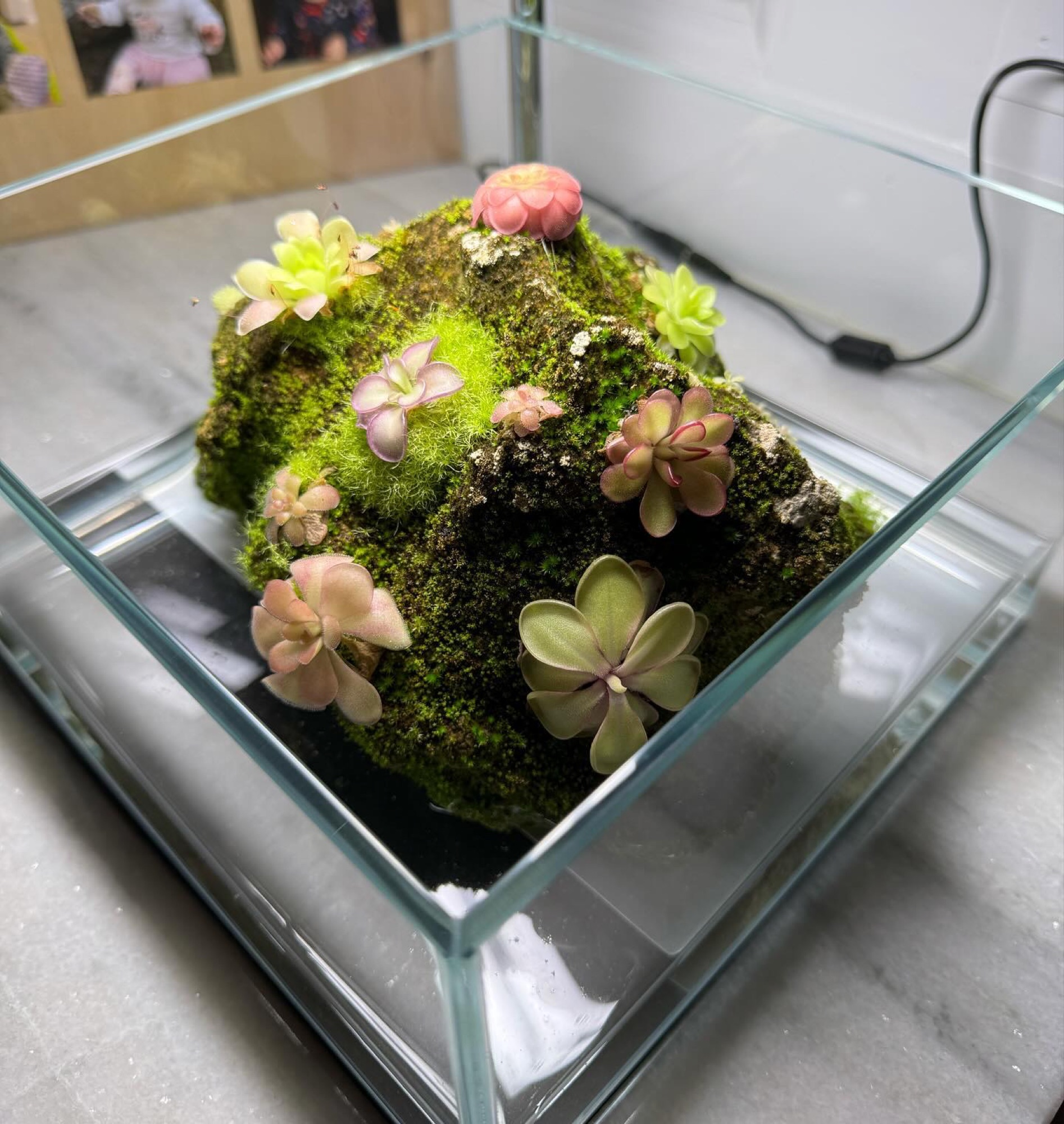
A Ping Rock is a porous rock planted with Mexican butterworts (Pinguicula). The plants root into pockets in the rock, the rock wicks water up from a shallow tray, and over time it fills in to a small living landscape — green and pink rosettes in summer, tight succulent ones in winter, and flowers on top.
It's not a gimmick, either. Many Mexican butterworts grow this way in the wild, clinging to crevices in limestone and gypsum cliffs where water collects. A Ping Rock is a tabletop version of that.
If you've picked up a Ping Rock kit from us, this is the care sheet that goes with it.
Choosing a rock
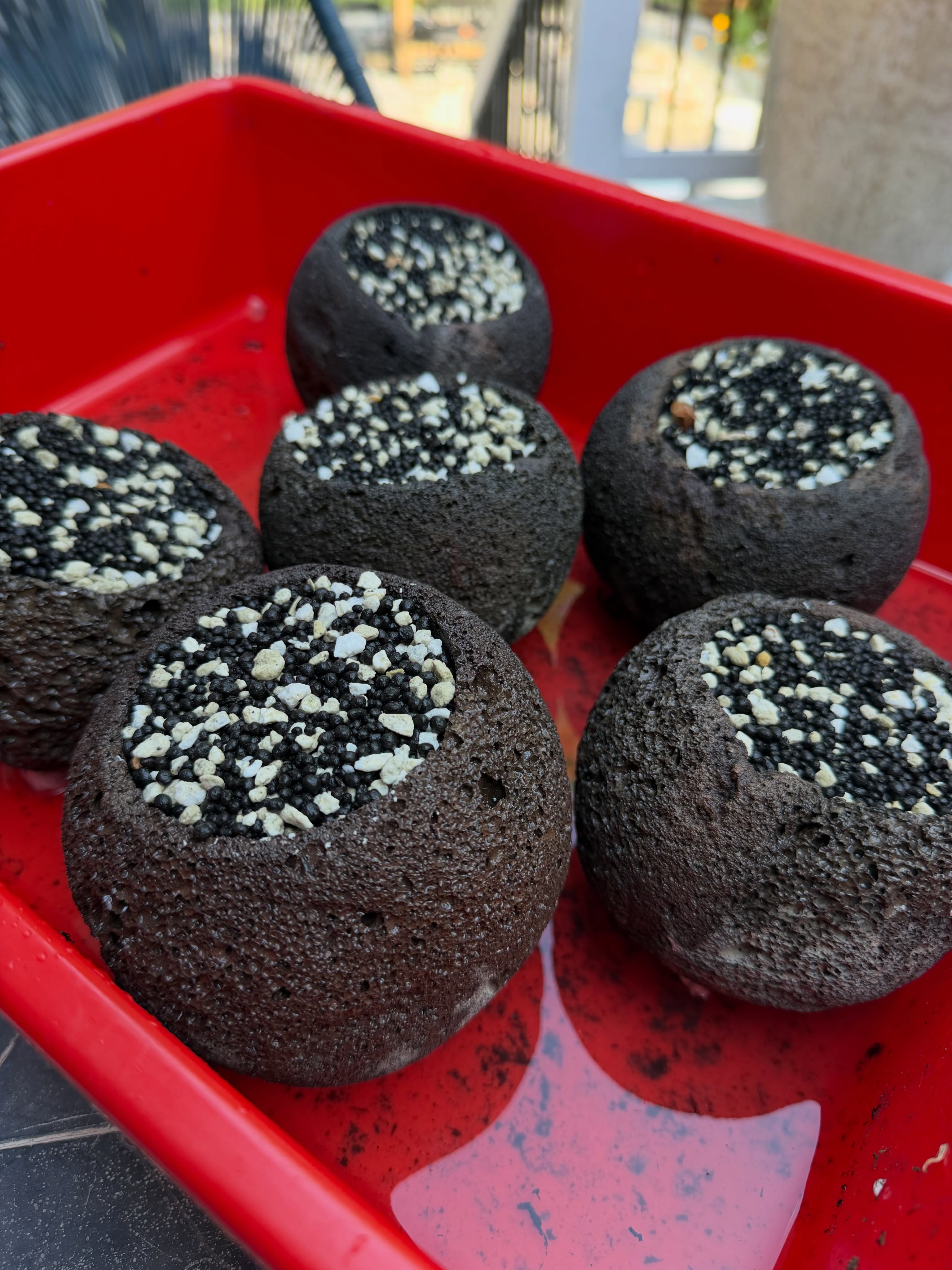
The rock needs to be porous, so it pulls water up to the roots. Volcanic rock is ideal: pumice wicks most reliably, and lava rock (scoria) is denser with bigger pockets. Both work well — we use lava rock.
A few things to look for:
- Pockets and crevices where a plant can sit. If there aren't enough, you can drill holes.
- Not too tall. Water only wicks up so far; on a tall rock, the top dries out.
- A flat, stable base, so it doesn't tip over in its tray.
- Lighter colors if it'll see direct sun. Dark rock heats up fast and can cook the plants.
Before planting, soak the rock in a tray of water overnight and check that the spots you want to plant actually stay damp.
Choosing your plants
Kits come with the rock, not the plants. When you're ready, get in touch and come pick your butterworts from our collection in person — we'll help you choose a mix that grows at a similar pace and looks good together.
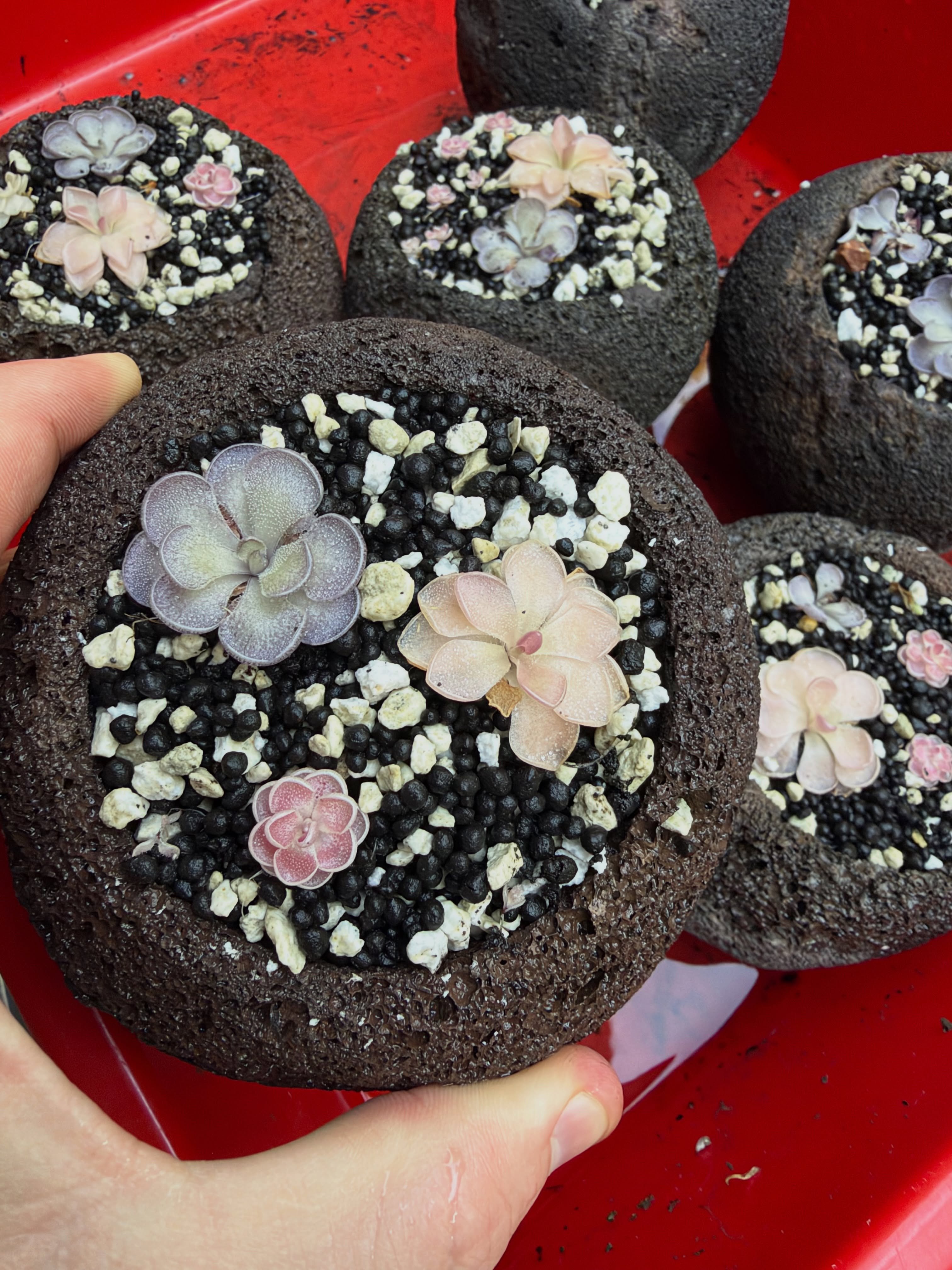
Almost any Mexican Pinguicula will take to a rock. Species that grow on rock in the wild, like P. agnata and P. gypsicola, are natural choices, but growers have good results with P. laueana, P. cyclosecta, the P. moranensis group, and hybrids like P. 'Aphrodite' too. Mixing a few species gives you different leaf colors and staggered blooms.
Planting
- Prep the plants. Gently wash the old media off the roots. Mexican butterworts have small, shallow root systems, so this is quick.
- Fill the pockets. Pack a little of your mix — we use perlite topped with Fluval Stratum — or a pinch of sphagnum moss into each hole. This anchors the plant until its roots grip the rock.
- Tuck in the plants. Set each rosette into a pocket and press the media around its base. Tweezers help on small plants.
- Water gently. Mist, or pour slowly into the tray, so nothing gets knocked loose.
Care
Water: Sit the rock in a shallow tray of pure water — RO, distilled, or rain. We keep about half an inch in the tray. The water level should stay below the leaves but high enough that the rock keeps the roots moist. Avoid mineral-heavy tap water: besides bothering the plants, it leaves crusty white deposits on the rock. Swap the tray water now and then if algae builds up.
Light: Bright. An east window or a spot under strong grow lights is ideal. Plenty of light keeps rosettes compact and colorful and keeps mold away; harsh all-day direct sun can burn leaves (and heat the rock).
Temperature: Ordinary household temperatures, 60–80°F (15–27°C). Moderate to high humidity helps but isn't required.
Feeding: They'll take care of your fungus gnats. With no bugs around, an occasional small insect or a light foliar carnivorous-plant fertilizer is plenty.
Winter
Most Mexican species swap their sticky leaves for small, succulent, non-carnivorous rosettes in fall and winter. When you see that change, cut way back on water — let the tray go dry and keep the rock just barely damp. Species from drier habitats rot easily in this phase and should be kept dry. Resume normal watering when sticky carnivorous leaves return in spring. Winter is also when many species bloom.
If your rock lives under grow lights year-round, shortening the light schedule in fall helps trigger this rest.
Keep the moss off
Moss — especially star moss — will try to creep across the rock. Don't let it. It crowds the base of the rosettes, stops them from putting out offsets, and eventually chokes plants out. Pick it out whenever you see it starting; it's far easier to remove early than once it's matted around the plants. (Most of our own ping repotting is just picking off star moss.)
What to expect
Plants on a rock tend to stay a bit smaller than the same plants in a pot — there's simply less room. You're trading size for a display that looks like a piece of habitat and needs very little upkeep once it's established.
For more detail on the plants themselves, see our Mexican Pinguicula care guide.
Further reading
- Alvin Liu, "Lithophytic culture of Mexican Pinguicula," Carnivorous Plant Newsletter 49(3), 2020
- Christina Toole, "Pinguicula fountain displays with pumice", Tom's Carnivores
- Daniela Ribbecke, "How to build a Pinguicula wall", California Carnivores